
No products in the cart.

Muslim Wedding Dress: Modest Outfits for Every Wedding Event
Choosing a Muslim wedding dress means planning for several events, not just one day. From the Mehndi to the Nikah and the Walima, each occasion has its own mood, and the outfits need to be festive, modest and comfortable for long hours.
This guide covers outfit ideas for each event, regional traditions across India, colours and fabrics, and how to style the hijab so the whole look comes together.
In this guide
- What makes a Muslim wedding dress modest?
- Outfits for each wedding event
- 8 Muslim wedding dress ideas
- Regional traditions in India
- Colours and fabrics
- Hijab styling for the bride
- Planning timeline
- Outfits for the bride’s family
- Comfort on the big day
- Wedding pieces at Modesty EStore
- Frequently asked questions
- Choosing your Muslim wedding dress
What makes a Muslim wedding dress modest?
- Full coverage: long sleeves and a full-length hem.
- Loose fit: nothing tight or shaping.
- Opaque layers: lining under net, organza or chiffon.
- Coordinated hijab: chosen with the outfit, not added at the end.
The Wikipedia article on Nikah explains the marriage ceremony these outfits are made for.
Outfits for each wedding event
| Event | Mood | Outfit idea | Hijab |
|---|---|---|---|
| Mehndi | Colourful, relaxed | Yellow or green sharara, floral abaya | Embroidered edge |
| Nikah | Sacred, elegant | Red, maroon or white with gold work | Satin, veil |
| Walima | Festive, evening | Pastel or jewel-tone abaya or gown | Stone work |
| Reception | Glamorous | Open-front abaya over a gown | Shimmer or satin |
For the feast itself, read our walima dress guide.
8 Muslim wedding dress ideas
- Red lehenga with a matching hijab for a traditional Nikah.
- White or ivory gown with a gold-bordered satin hijab.
- Embroidered abaya over a long inner dress for full modesty.
- Sharara or gharara with a long kurta and dupatta pinned over the hijab.
- Silk saree with a full-sleeve blouse and satin hijab.
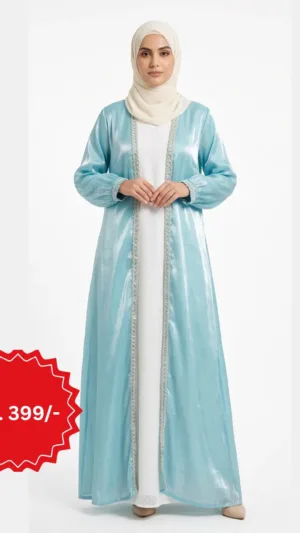
- Open-front abaya with trim over a pastel gown for the Walima.
- Plum or navy outfit with a stone-work hijab for evening events.
- Floral abaya in yellow or green for the Mehndi.
Our pillar guide to the bridal abaya covers abaya styles for the bride in depth.
Regional traditions in India
- Hyderabad: the khada dupatta, a long kurta, churidar and a large dupatta, is a cherished Nikah tradition.
- Lucknow: gharara and sharara outfits with fine chikankari or zari work.
- Kerala: brides often wear a silk saree or gown with a hijab or head scarf.
- North India: red or maroon lehengas with heavy embroidery remain popular.
Many modern brides blend these traditions with an abaya or a hijab styled for photos.

Colours and fabrics
- Red and maroon: traditional and festive.
- White, ivory and gold: elegant for the Nikah.
- Pastels: soft and modern for daytime events.
- Silk and satin: rich sheen for the main ceremony.
- Georgette and net: light and flowing, always lined.
Our abaya material guide compares fabrics for comfort and opacity.
Hijab styling for the bride
The hijab frames the face in every photograph. Choose it at the same time as the outfit and practise the style before the day.
Our hijab style for wedding guide shows seven bridal wraps, from pleated satin to a veil over the hijab.
Planning timeline
- Three months before: decide on outfits and colours for each event.
- Six weeks before: order custom pieces and alterations.
- Three weeks before: order ready-made hijabs, pins and accessories.
- One week before: full trial of every outfit with shoes and hijab.
Outfits for the bride’s family
Sisters, mothers and cousins often coordinate colours for photographs. Simpler styles in the same colour family keep the focus on the bride.
Matching hijabs in one shade, worn with different outfits, give lovely group photos without everyone needing the same dress.
Comfort on the big day
- Breathable lining: heavy outfits are easier to wear with a soft cotton lining.
- Secure hijab: an inner cap and long pins keep everything in place for photos.
- Comfortable shoes: keep a flat pair for the long hours of greeting guests.
- Emergency kit: safety pins, spare pins, tissues and a small mirror.
A beautiful Muslim wedding dress is easier to enjoy when you are comfortable. Ask a sister or friend to carry the kit so you can focus on the day.
After the wedding, many brides re-wear their hijabs and abayas at family functions and Eid, so choosing versatile colours pays off for years.
Wedding pieces at Modesty EStore
Every piece below is in stock and photographed by us. Delivery is a flat ₹45 anywhere in India and free on orders of ₹999 or more, and you can pay online with PhonePe or choose cash on delivery.
For the wedding events
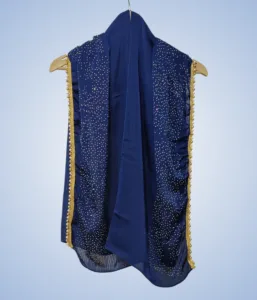
- Wedding Hijab Scarf – Navy – stone work and pearls, ₹299
- Satin Scarf – Bridal Satin Hijab – soft drape, ₹299
- Gold-Embroidered Fancy Bridal Hijab – 14 colours, ₹350
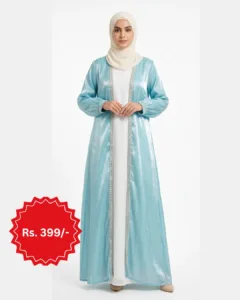
- Light Blue Shiny Open-Front Abaya – for the Walima, ₹399
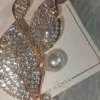
- Pagdi Brooch – Leaf and Pearl – statement, ₹200
- Crystal Teardrop Long Hijab Pins – set of 35, ₹500
Frequently asked questions
What does a Muslim bride wear?
It depends on the region and family. Common choices are a lehenga, sharara, saree or gown with a hijab, or an embellished abaya over a long dress.
What colour is a Muslim wedding dress?
Red and maroon are traditional in India; white, ivory, gold and pastels are popular modern choices.
Can a Muslim wedding dress be an abaya?
Yes. Many brides choose an embroidered or open-front abaya for a fully modest look.
How many outfits does a Muslim bride need?
Usually three or four: Mehndi, Nikah, Walima and sometimes a reception outfit.
What should the bride’s family wear?
Coordinated colours in simpler styles, so the bride stands out.
How much does a wedding hijab cost?
Our bridal hijabs cost ₹299 to ₹350. Delivery is ₹45, or free on orders of ₹999 or more.
Choosing your Muslim wedding dress
The right Muslim wedding dress balances tradition, modesty and comfort across several events. Plan an outfit for each occasion, choose the hijab alongside it, and leave time for a full trial before the day.
Explore the bridal pieces above to complete your wedding wardrobe.

Related posts
Walima dress guide: modest outfit ideas for the bride, family and guests, colours, fabrics, hijab...
Hijab style for wedding guide: 7 bridal and guest looks, from pleated satin to Turkish...
Eid outfit ideas for women: 8 modest looks with abayas, prayer dresses, festive hijabs and...
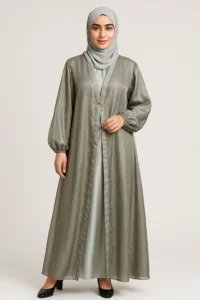
Bridal abaya guide: 6 wedding abaya designs, the best colours and fabrics, hijab pairing, budgets...
Add comment